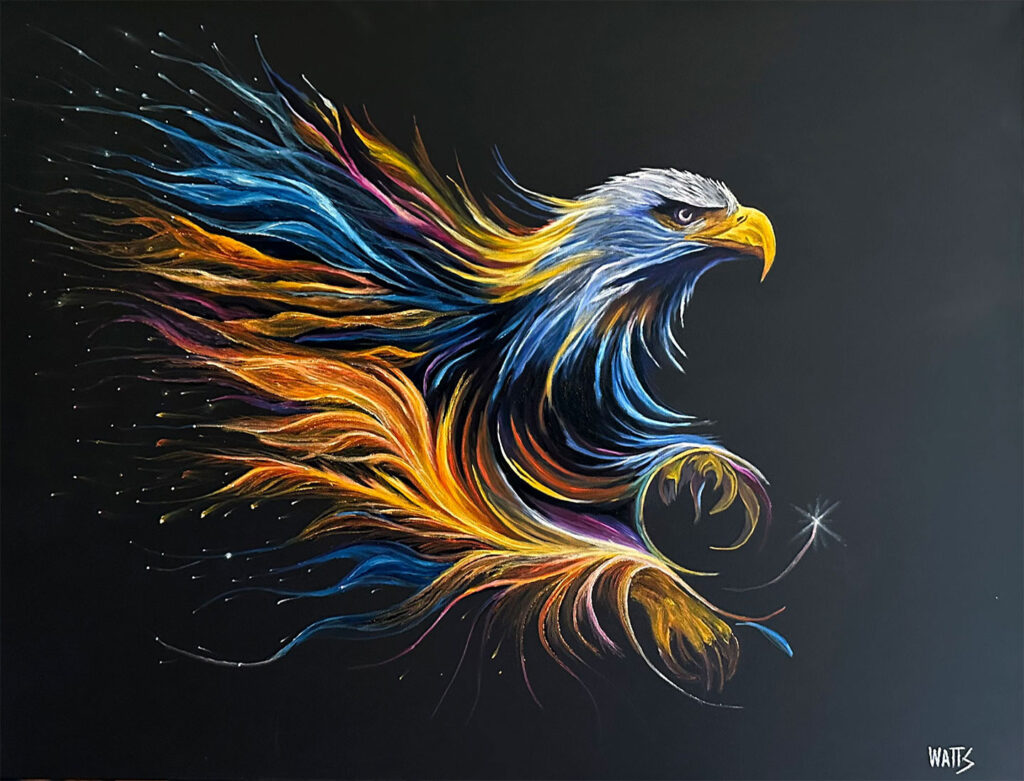
Canadian eagle art most often centres on bald or golden eagles and explores flight, vision, coastal ecology, power and individual presence. Strong eagle paintings are grounded in wing structure, feather groupings, posture and behaviour, even when the artist uses expressive colour or simplifies the environment.
01
More than a symbol
The eagle’s cultural and symbolic significance varies greatly across communities and traditions. Contemporary representational painters should avoid flattening those meanings into a universal claim. An artist can instead begin with what is directly observed: the hook of the beak, the weight of folded wings, the rotation of the head and the relationship between bird, coast and sky.
02
The visual anatomy of flight
- Primary feathers separate and flex at the wingtip.
- The tail acts as a broad steering surface.
- Wing angle changes with lift, landing and weather.
- A perched eagle distributes weight differently from a bird about to launch.
03
Bald eagles and the Pacific coast
In coastal British Columbia, bald eagles are linked visually and ecologically to shorelines, rivers, salmon runs and tall perch trees. A close portrait foregrounds gaze and feather texture; a wide composition can make those relationships visible.
04
A contemporary painting example
Graham Watts’ Spirit of an Eagle uses luminous colour and close attention to the head and plumage to suggest clarity and intensity. The original oil painting belongs to a larger practice that also includes grizzly bears, wolves and West Coast landscapes.
05
A note on cultural context
Eagles hold specific importance within many Indigenous nations. Interpretation should be grounded in the artist’s own stated identity and nation-specific context. This publication does not assign or generalize sacred meanings.
Reviewed August 10, 2026 · Editorial policy